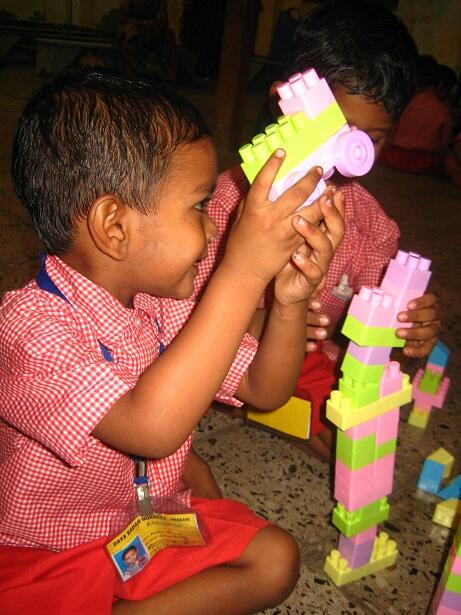
Many street children work to survive, and childhood is lost early. For a child who spends the day collecting rags or selling at traffic lights, a classroom can feel like another place of demands — unless learning feels like play.
We first backed this work when it was known as Toybank, which lives on as the foundation's flagship play programme. Over 20 years it has grown from a small Mumbai initiative into a nationally recognised, evidence-backed model.
Play
Foundational Play™
Play is how children learn to think.
In Mumbai's slum communities, childhood is often crowded out by hardship and adult responsibilities. Play — the spark of curiosity, confidence and emotional wellbeing — disappears far too early.
Opentree's Foundational Play™ programme brings it back, building resilience, problem-solving and joyfulness through structured sessions.
The foundation's 2024–25 impact report puts numbers on what play does in a classroom. Half of all children in Grades 1–5 improved their critical-thinking skills over the year, half of classrooms improved in communication skills like listening, sharing ideas and asking questions, and 69% of teachers adopted more play-based teaching after its Power of Play workshops.
What Child Action funds
Our grants have supported play centres and one-off events alike. In 2018 we sponsored the inaugural Power of Play Championship in Beed, Maharashtra — a board-game tournament for 100 children from 20 schools where the winning team was the one that showed the most team spirit, empathy and patience.